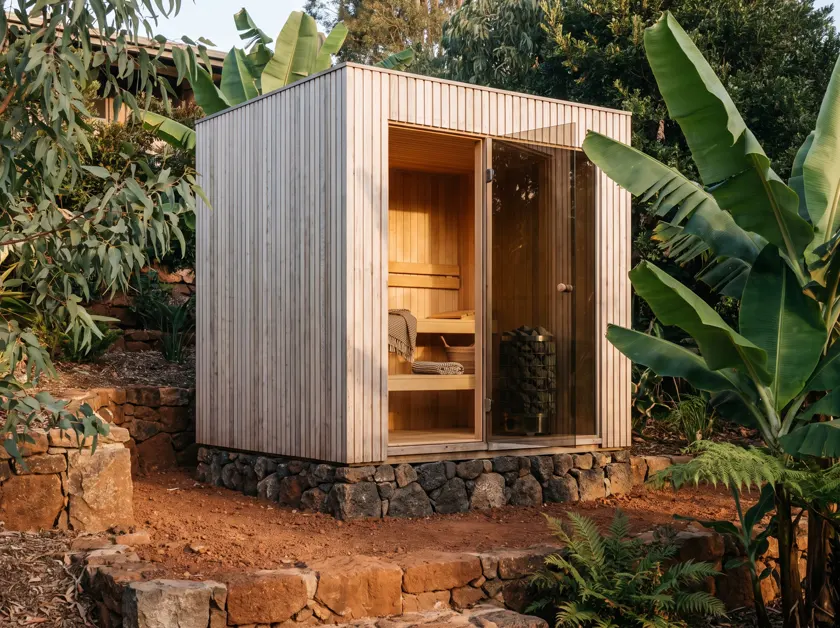
Outdoor & garden saunas
Almost every plot we work on in Kigali is terraced. That single fact decides most of the engineering: a garden…
Read more →A sauna that fits a Kigali hillside is not a box you order from a catalogue. The slope decides the foundation, the access road decides how the panels arrive, and the altitude decides the heater.
Indicative band: 3.2–9.5 million RWF, supplied and installed.
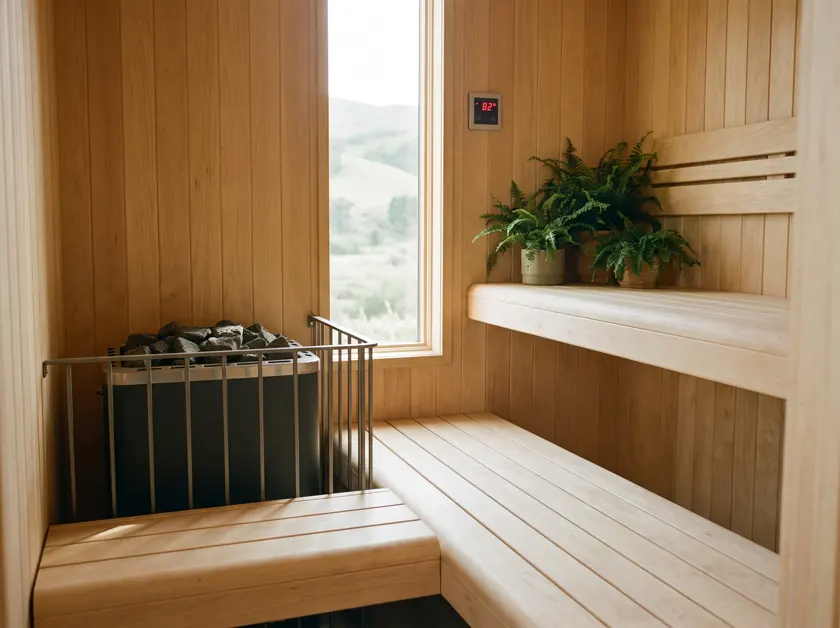
Kigali sits at roughly 1,450 m. Air is thinner, so a given heater moves less mass of air per kilowatt, and the cabin reaches working temperature more slowly than the same cabin at sea level. We size the heater on cabin volume first — about 1 kW per cubic metre for an insulated cabin — then add a margin for altitude and for every square metre of glass.
Glass is the other half of the sum. A cabin with one full-height glass wall loses heat far faster than a solid one, and on a ridge in Rebero or Nyarutarama where evening air drops to 16-17 °C, that difference is the one people feel. We count glass as roughly one and a half times its area in the heater calculation and say so in the quote.
Rwanda has plenty of eucalyptus, and it is the wrong wood for a hot room. It is resinous, knotty and moves badly under repeated heat cycles — knots get hot enough to burn skin and resin bleeds onto benches. We use thermo-treated aspen and thermo-treated pine for linings and benches: kiln-treated at around 200 °C, dimensionally stable, low resin, and it does not scorch the back of your legs.
What we do buy locally is everything that is not in the hot room: volcanic basalt for plinths and bench bases, Rwandan brick for surrounds, and steel for the sub-frame. That keeps the imported share of a cabin down and shortens the lead time.
A two-person cabin fits a 1.2 × 1.5 m footprint and lands in an apartment bathroom in Kimihurura. A family cabin at 2.0 × 2.4 m seats four comfortably on two tiers. A lodge or club cabin runs from 3.0 × 3.6 m upward with three tiers and a tower heater in the middle. Above roughly eight people we move to a commercial control panel with a timer and an external switch, because someone has to be responsible for shutting it down.
Six to ten weeks for a standard cabin once the drawing is signed. The imported timber is the long pole: sea freight to Mombasa or Dar es Salaam runs 35–42 days, then 5–10 days overland to Kigali. If we have the section in stock at the Gisozi workshop, it is three to four weeks.
Up to about 8 kW, yes, if the house supply and cable can carry it. Above that we ask for a three-phase connection — REG supplies 400 V three-phase and the meter fee is the same RWF 56,000 for single or three phase, so the cost is in the cabling, not the meter.
Electric for anything in the city: it is controllable, it does not need a flue through a tiled roof, and nobody has to carry wood up a terrace. Wood-fired makes sense at a lodge in Musanze or on Lake Kivu where the fire is part of the evening and firewood is already on site.
Almost every plot we work on in Kigali is terraced. That single fact decides most of the engineering: a garden…
Read more →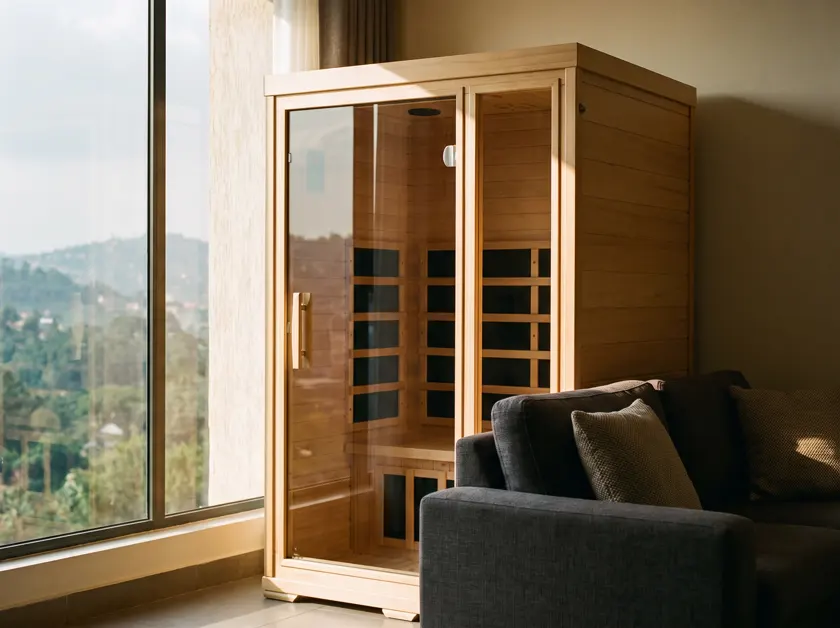
An infrared cabin is the answer when there is no three-phase supply, no drain and no room for a hot room — whi…
Read more →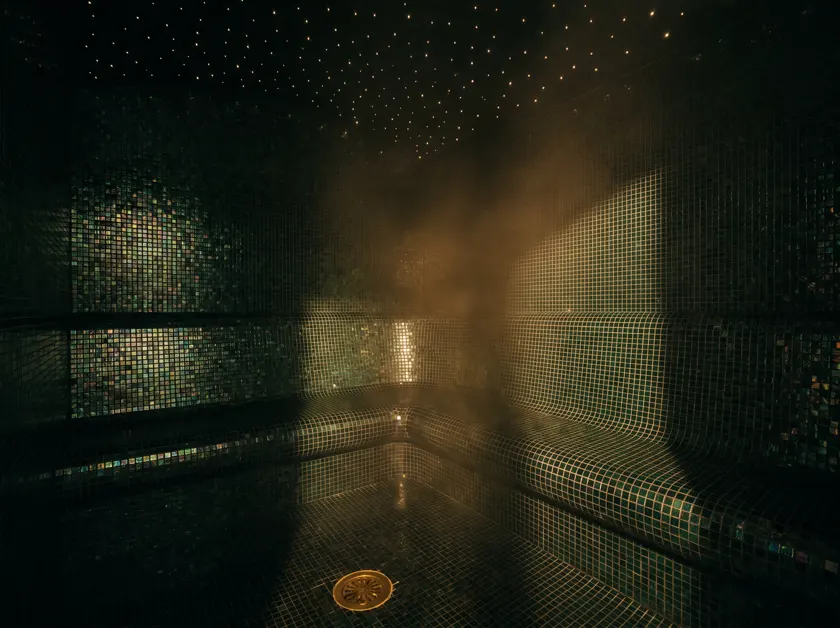
A steam room is a waterproofing job wearing a tiled finish. Nearly every failed steam room we are called to fi…
Read more →