
9 min
What a Sauna and Cold Plunge Cost in Rwanda in 2026
An honest breakdown of sauna and cold plunge prices in Rwanda: what sits in the lower bands, what pushes a cab…
Read more →Kigali sits at about 1,450 m (Climates to Travel). Almost every heater sizing chart in existence assumes sea level. The gap between those two facts is why some cabins in this city never quite get hot — and why cold water here is unusually cheap.
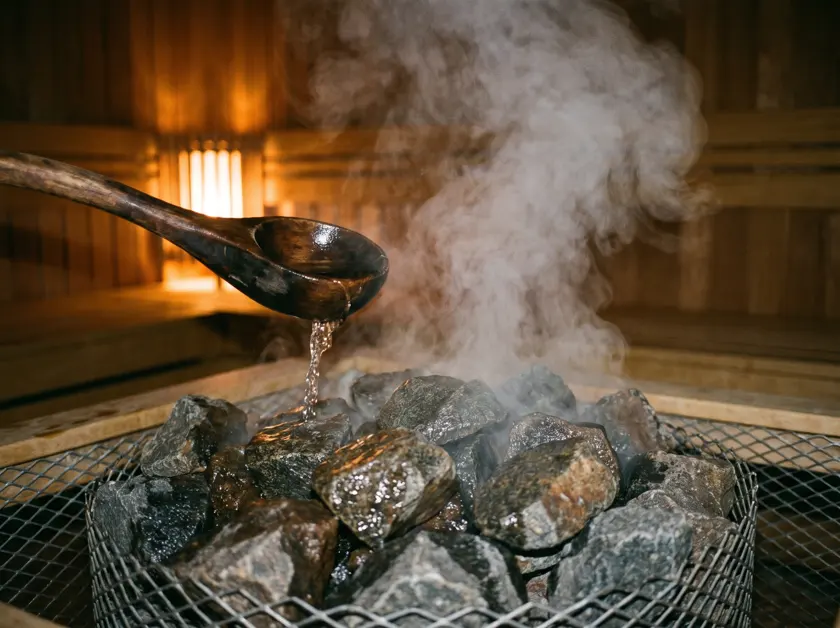
The base rule is about 1 kW per cubic metre of insulated cabin. A 2.0 × 2.4 m cabin at 2.1 m high is roughly 10 m³, so a 9 kW heater is the starting point. Not the answer — the starting point.
That figure assumes a genuinely insulated cabin with a vapour barrier, a sensible vent path and a door that seals. Every one of those assumptions is violated somewhere in this city, and when they are, no amount of heater fixes it. We would rather add insulation than kilowatts, every time.
Thinner air carries less heat per unit volume, and a sauna heater's job is precisely to heat air and stones which then heat the room. At Kigali's elevation we add capacity rather than hoping. In practice that usually means choosing the next heater up rather than the one the chart specifies.
It costs a modest amount on day one and it is the difference between a cabin people use and a cabin people apologise for. The commonest fault we are called to fix in Kigali is a room that climbs to 70 °C and stalls — the cabin is fine, the sizing was done for a different country.
Higher up, the correction grows. In Musanze, at roughly 1,850–2,500 m, we recalculate on the lodge's actual elevation rather than on a national figure, because the difference between the bottom and the top of that range is another step on the heater.
Glass loses heat far faster than an insulated wall. We count glazed area at roughly one and a half times its physical size when totalling the surface the heater has to hold, which in practice means a cabin with one full glass wall can need a heater a full step larger than the same cabin built solid.
This is not an argument against glass. On a Kigali ridge, glass is the entire reason to build the cabin where you are building it. It is an argument for putting the glass in the drawing before the heater is chosen instead of afterwards, and for accepting the heater that results rather than negotiating it down.
A 9 kW heater does not draw 9 kW continuously. It pulls full load during heat-up — twenty to forty minutes depending on insulation — then cycles to hold temperature, typically at a third to a half of nameplate. An evening session is closer to 4–6 kWh than to 9.
Insulation changes that figure more than anything else you can buy. The same heater in a well-insulated cabin spends far more of the session idle, which is why we push insulation ahead of size in every conversation and why the best-value cabin in our range is a small one built properly rather than a large one built to a price.
Up to about 8 kW you can usually stay single-phase if the supply and the cable allow. Above that, three-phase. REG supplies 400 V three-phase and charges the same RWF 56,000 meter fee for either (REG New Connection Policy), so the decision is about the board and the cable run rather than about the meter.
That cable run is the line that varies most. Twelve metres across a garage is trivial; forty metres down a terraced garden is a real cost, and it is dramatically cheaper before the garden is laid than after.
A chiller does not cool water in the abstract. It fights the gap between your target temperature and the air around the tub, and in Kigali that gap is unusually small.
The city runs at roughly 26–28 °C by day and 16–17 °C at night, averaging 20.7 °C over the year (Climates to Travel). A coastal East African city sits several degrees warmer by day and, far more importantly, barely cools at night. For a tub held at 8 °C it is the overnight difference that decides the electricity bill: in Kigali the compressor spends the night doing very little, and at the coast it works through it.
That buys three things. Lower electricity. A smaller unit for the same tub. And a longer working life, because compressor wear tracks run hours much more closely than it tracks age.
Because the nights are cool, a shaded, insulated, lidded plunge held at 15–18 °C frequently needs no chiller at all in Kigali. Mains water and night air will do it, and 15–18 °C is the temperature most people actually enjoy and use repeatedly.
We say so, out loud, at quotation stage, even though it removes a substantial item from our own invoice. A client who was talked into a compressor they did not need is a client who tells their friends exactly that.
For a true 4–6 °C ice bath you do need a machine, and we size it properly. Between those two positions there is a genuinely useful middle that almost nobody in this city is offered.
None of the above helps an uninsulated tub sitting in the afternoon sun. Heat gain through the shell and evaporation from an open surface will beat any chiller you attach to it.
We build tubs as an insulated shell with closed-cell insulation in the cavity, insulate the base as well as the walls, and supply a lid that actually fits. The lid is the cheapest component in the system and the one that saves the most money — and most people stop using it within a month, which is why we make it light enough to lift with one hand.
1 HP for tubs up to about 260 litres, 2 HP to about 570, 4 HP to about 1,200 — then step up if the tub sits in sun, serves a team back to back, or is held at 4 °C rather than 8–10 °C.
Two thirds of the chillers we are asked to repair in this country were sized for a tub smaller than the one they were sold with. The unit is not faulty. It was never going to work, and no service visit will change that.
Send us a model number before you buy something yourself. It is a two-minute answer and it has saved several clients a very expensive ornament.
Want this checked against your own room? Send us the dimensions and a photograph and we will come back with a drawing.
An honest breakdown of sauna and cold plunge prices in Rwanda: what sits in the lower bands, what pushes a cab…
Read more →
Every imported component reaches landlocked Rwanda through somebody else's port. The two corridors, realistic …
Read more →
Eucalyptus is Rwanda's most available timber and the first thing every client asks about. Why it fails in a ho…
Read more →