9 min
What a Sauna and Cold Plunge Cost in Rwanda in 2026
An honest breakdown of sauna and cold plunge prices in Rwanda: what sits in the lower bands, what pushes a cab…
Read more →Eucalyptus is the most available timber in Rwanda and the first thing every client asks about. The answer is no — for the hot room. Everywhere else, local materials do most of the work.
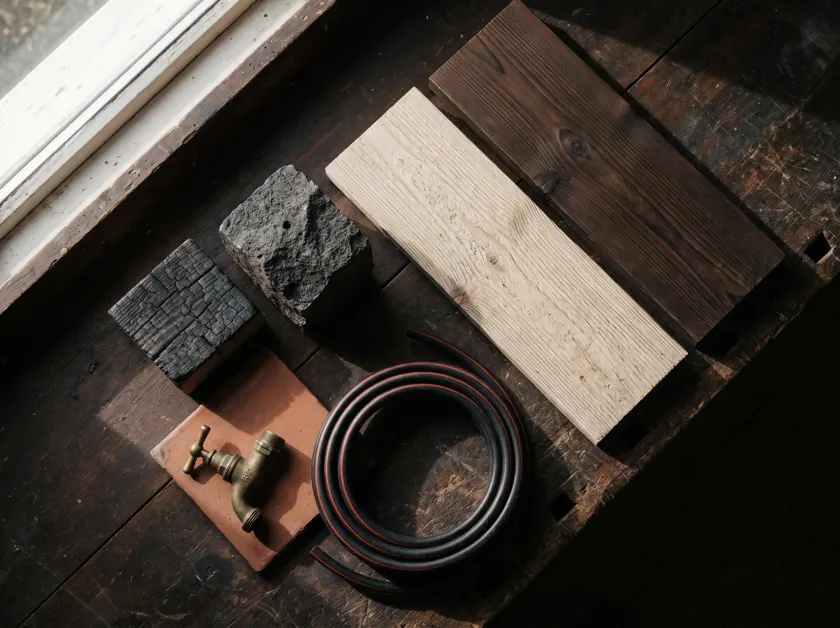
A hot room cycles from ambient to 90 °C and back, repeatedly, with humidity swinging sharply each time water hits the stones. Timber that moves under that cycle opens joints, cups benches and works fixings loose — not dramatically, but steadily, over two or three years, until a cabin that was tight at handover rattles.
Resin is the second problem. Resinous species bleed at sauna temperatures, and resin on a bench is unpleasant, sticky and permanent. It also darkens unevenly, so a bench that bleeds looks neglected long before it is.
Knots are the third. A knot conducts heat differently from the surrounding wood and can reach a temperature that will genuinely burn skin. On a bench top a knot is not a character feature, it is a hazard, and this is why clear grades cost what they cost.
Rwandan eucalyptus is resinous, generally knotty and moves considerably as it dries and re-wets. It is an excellent timber — for construction, framing, poles, scaffold and firewood — and the country is full of it for good reasons.
It is simply the wrong material to press your back against at 90 °C. We have been asked to line hot rooms in it perhaps a dozen times and have declined every time, and we have been called to repair two cabins where somebody did not decline. Both had to be stripped.
The same applies to most other locally available softwoods here for the same three reasons. This is not a slight on Rwandan timber; it is a very specific set of requirements that very few species meet anywhere in the world.
Thermo-treated aspen for linings and benches: heat-treated at around 200 °C, which drives out resins and stabilises the fibre. It stays cool to the touch at sauna temperatures, does not bleed, and holds its dimension through the cycle. It is the default for bench tops in serious saunas worldwide for exactly these reasons.
Thermo-treated pine where a darker, warmer tone is wanted, which in a cabin with a lot of glass is often the better-looking choice because it reads as a room rather than as a box.
Both are imported, and that is the honest trade-off: the hot room is the one part of the build we do not source in Rwanda. We would rather say that plainly than dress up a local substitution as a virtue.
Timber is conditioned in Kigali's climate rather than in a dry warehouse before it is cut, because wood that is cut at one moisture content and installed at another will move whatever species it is.
End grain is sealed as it is cut, in the workshop, before any panel goes together. Sealing after assembly reaches perhaps half of it — the cut ends inside joints, where moisture actually collects, are unreachable. It adds a day to fabrication, it is completely invisible in the finished cabin, and it is the reason our joints stay tight.
Benches are fixed from below, with no visible fasteners and no metal where skin lands. It sounds obvious. It is skipped constantly.
Volcanic basalt for plinths, bench bases, plunge surrounds and carved tubs. It is local, it is genuinely beautiful, it is thermally useful, and a carved basalt basin is the single most site-specific thing we make. It also has real mass, which is why anything holding water on a suspended structure gets an engineer's opinion before we quote it.
Rwandan brick for surrounds, terraces and plinths — warm, textured, locally fired and entirely appropriate next to dark timber.
Steel for sub-frames, cut and welded in Gisozi. Glass, ironmongery, insulation and sundries from local suppliers. And the labour, which is the largest single line in most projects and is entirely Rwandan.
On a typical cabin, the imported share by value is concentrated in three items: the hot-room timber, the heater and — where there is one — the chiller. Everything else is local.
Those three are also exactly where buying cheap costs you twice. A cabin lined in the wrong timber has to be stripped. An undersized heater has to be replaced. A chiller sized for a smaller tub than the one it was sold with will run continuously, never reach setpoint and fail early.
So the honest way to save money on a Rwandan sauna is not to substitute the timber. It is to build a smaller cabin, use a brick plinth instead of basalt, skip the glass wall, and keep the specification on the three imported items exactly where it should be.
Sauna stones are not decorative gravel. They need to be dense, non-flaking and free of anything that will crack under thermal shock, and they need turning or replacing every two to four years because they pack down, choke airflow and eventually burn out the element.
We supply proper heater stones with every cabin and we turn them at every service visit. Clients who source their own from a riverbed are, occasionally, lucky. More often we are called out to a heater that failed for an entirely preventable reason.
It is a small item and it is the one piece of maintenance that most affects how a cabin performs a few years in.
Behind the timber there is the part that actually determines how a cabin behaves. Mineral wool of the right density in the right thickness, then a continuous foil vapour barrier on the warm side with every joint lapped and taped, then a battened air gap, then the lining.
Each of those has a failure mode we have been called to. Insulation compressed by being forced into a frame that is too tight loses much of its value. A vapour barrier taped with the wrong tape lets go within two years in this humidity. No battened gap means the lining sits directly against the foil, which traps moisture against the back of boards that are supposed to be drying between sessions.
None of it is visible at handover, which is exactly why it is where corners get cut. It is also why we insist on being the ones who build the shell rather than lining somebody else's.
An outdoor cabin here faces two wet seasons a year and afternoon downpours that arrive faster than anyone can cover anything. That changes the outside of the building without changing the inside.
Deep eaves rather than a flush roof edge. A drained and vented cavity behind the cladding so water that gets in has a route out. A ventilated void beneath the cabin rather than a floor sitting flat on a terrace. And a plinth that lifts the timber clear of splash, which on a brick or basalt plinth is free because the plinth is there anyway.
Charred cladding — shou sugi ban — performs genuinely well here and is not only a look: the charred layer is dimensionally stable and sheds water. It costs more and we recommend it on exposed ridge sites where a cabin is taking weather from every direction.
Eucalyptus for the frame of the building, never for the hot room. Thermo-treated aspen or pine inside, sealed at the end grain before assembly, conditioned in Kigali before it is cut. Basalt, brick, steel, glass and labour local. Proper stones, turned on schedule.
Get those right and a cabin here lasts fifteen years looking like it did at handover. Substitute the timber to save a percentage and you will find out why nobody else does.
Want this checked against your own room? Send us the dimensions and a photograph and we will come back with a drawing.
An honest breakdown of sauna and cold plunge prices in Rwanda: what sits in the lower bands, what pushes a cab…
Read more →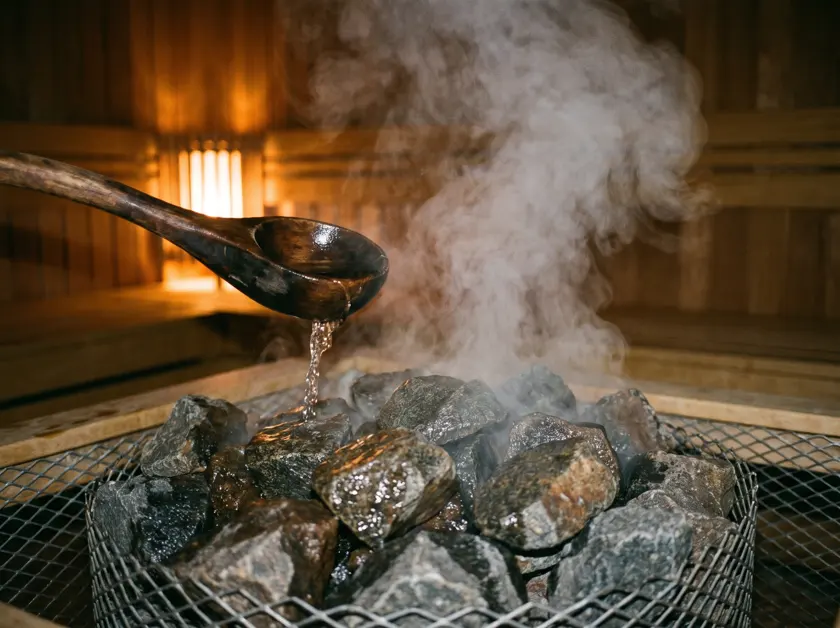
Why a heater sized from a sea-level chart never gets properly hot in Kigali — and why the same 1,450 metres ma…
Read more →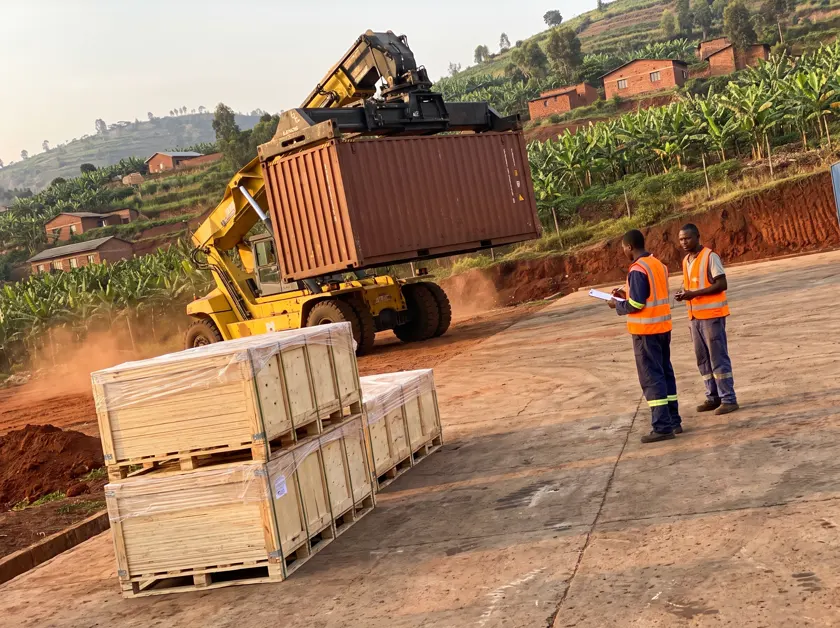
Every imported component reaches landlocked Rwanda through somebody else's port. The two corridors, realistic …
Read more →