
8 min
What a Sauna and Cold Plunge Cost in Rwanda in 2026
What a sauna and cold plunge cost in Rwanda in 2026: cabin, heater, chiller, duty, VAT and install in RWF, plu…
Read more →Two questions come up before almost every sauna we price in Rwanda: will my supply carry it, and what will it do to the REG bill? Both have precise answers, and neither is as frightening as people expect.
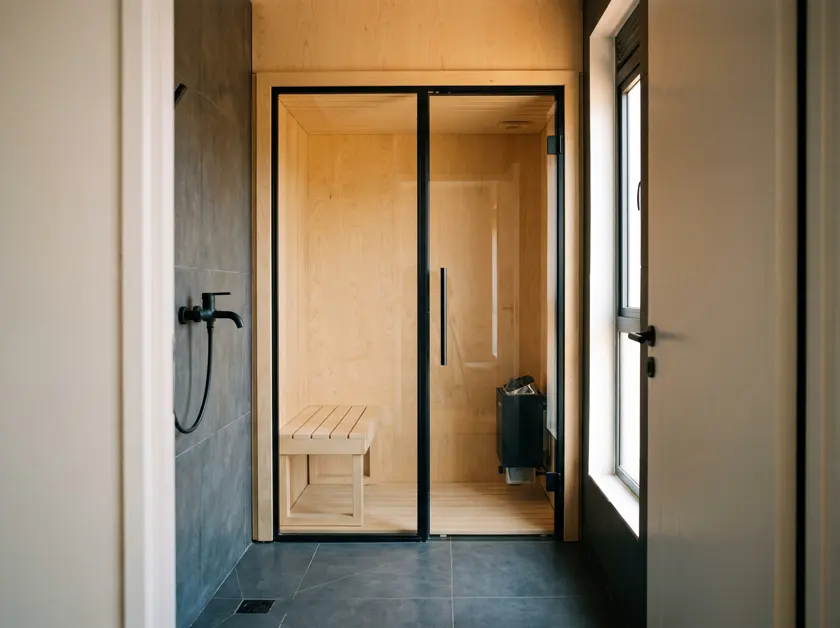
Rwanda's electricity tariffs were revised with effect from 1 October 2025 (REG; rates set under the regulator, RURA). The ones that matter for saunas, steam rooms and chillers are below, in RWF per kWh before VAT and the regulatory fee.
| Customer category | Monthly block | RWF per kWh |
|---|---|---|
| Households | 0–20 kWh | 89 |
| Households | above 20, up to 50 kWh | 310 |
| Households | above 50 kWh | 369 |
| Non-residential | 0–100 kWh | 355 |
| Non-residential | above 100 kWh | 376 |
| Hotels using under 660,000 kWh a year | all kWh | 239 |
| Hotels using over 660,000 kWh a year | all kWh | 175 |
The blocks make the sums simple. A villa with a sauna is almost certainly past 50 kWh a month already, so every kWh the heater draws is billed at the top household rate of RWF 369. A gym passes its first 100 kWh within days, so its recovery zone runs at RWF 376. Hotels are the exception: a flat RWF 239, falling to RWF 175 once annual consumption passes 660,000 kWh.
Heater size follows cabin volume. Our rule for Kigali is 0.85 kW per cubic metre, multiplied by 1.12 for the altitude, plus about 0.42 kW for every square metre of glass, rounded up to the next heater in the range. That puts a two-person cabin at 4.5 kW, a four-person cabin at 10.5–12 kW and a six-person cabin at 15–21 kW, depending on the glazing; heater sizing at Kigali's altitude has the full table.
The rating is what the heater draws while its elements are on. It is not what it uses over an evening, because a heater runs flat out only while the room warms up and then switches on and off to hold the temperature.
Rwanda's low-voltage network supplies 230 V single-phase and 400 V three-phase at 50 Hz (Rwanda Energy Group). Current is what limits a circuit. An 8 kW heater on 230 V single phase draws about 35 A, which is already a heavy domestic circuit. A 12 kW heater on 400 V three phase draws about 17 A per phase, which is far easier to cable and protect.
Hence our working rule: up to about 8 kW, a dedicated single-phase circuit is usually possible if the incoming supply allows; above that, three phase. The meter is not the obstacle — REG charges RWF 56,000 for a single- or a three-phase meter alike (REG New Connection Policy). What costs money is the upgraded supply, the board, the breaker and the cable to the cabin, and those depend entirely on your house.
Three phase does not change the price of a kWh. It only makes a large heater practical and safe to connect.
The table assumes a 35-minute heat-up at full power followed by an hour of bathing with the heater cycling at about 40 per cent, billed at the household top-block rate of RWF 369 per kWh. Insulation, the season and how often the door opens will move the numbers; treat them as a realistic order of magnitude.
| Cabin | Heater | kWh per evening | RWF per evening at 369 |
|---|---|---|---|
| Infrared, 2 person, 45 minutes | 2 kW | about 1.5 | about 550 |
| Sauna, 2 person, solid walls | 4.5 kW | about 4.4 | about 1,630 |
| Sauna, 4 person, solid walls | 10.5 kW | about 10.3 | about 3,800 |
| Sauna, 4 person, one glass wall | 12 kW | about 11.8 | about 4,350 |
| Sauna, 6 person, corner glazing | 21 kW | about 20.7 | about 7,600 |
Used three evenings a week, the four-person cabin with a glass wall adds roughly 150 kWh and RWF 56,000 a month to a household bill. Longer sessions, a door propped open or a cabin with no insulation under the floor push that up; a well-insulated cabin spends more of each hour with its elements switched off.
A commercial sauna runs for hours rather than for an evening. Take a 12-seat hotel cabin of about 20 m³ with a 21 kW heater, open from 4 pm to 10 pm: one heat-up of around 12 kWh, then six hours cycling at roughly 40 per cent, some 50 kWh, for about 62 kWh a day. At the hotel rate of RWF 239 that is close to RWF 15,000 a day, or around RWF 450,000 a month; a gym paying RWF 376 would spend about RWF 23,500 a day on the same cabin.
Two decisions cut that more than any tariff: a controller that switches the cabin off outside booked hours, and insulation good enough that the heater idles for most of each hour. At a lodge, sequencing the heater against the other big loads matters too; our hotel and lodge spa page explains how.
A steam generator behaves much like a sauna heater: full power while the room fills, then cycling to hold it. Its rating follows room volume and finish, and for a small domestic steam room it is of the same order as the heater for a sauna of similar size, so budget similar kWh per session.
Chillers are the smaller load. A compressor draws roughly 0.75 kW of electrical input per horsepower, so a 1 HP unit uses under 1 kW while running, and in Kigali, where nights fall to 16–17 °C, it runs fewer hours than in a hot lowland city. Six running hours a day on a 1 HP unit is about 4.5 kWh, roughly RWF 1,650 a day at the household top rate. An insulated lid is worth more than any tariff choice.
Where the grid is weak or absent, a sauna heater is the hardest load to carry on batteries: 21 kW for an evening means a very large bank. Lodges in Akagera and Nyungwe usually run heaters in the generator window and keep chillers, pumps and controls on solar, where they draw steadily and little. A wood-fired stove takes the heater out of the electrical system altogether where firewood is managed on site.
To see which heater and chiller your room needs, run the dimensions through the configurator, or read how we build a custom sauna around a known power supply.
Want these numbers worked out for your own room in Rwanda? Send the dimensions and a photograph — we answer within one business day with an itemised quote.
What a sauna and cold plunge cost in Rwanda in 2026: cabin, heater, chiller, duty, VAT and install in RWF, plu…
Read more →
Adding a sauna, steam room or plunge to a Rwandan hotel or lodge: grading, building permits, park rules, power…
Read more →
How big a sauna heater you need at Kigali's 1,450 m: kW per cubic metre, glass and altitude corrections, with …
Read more →