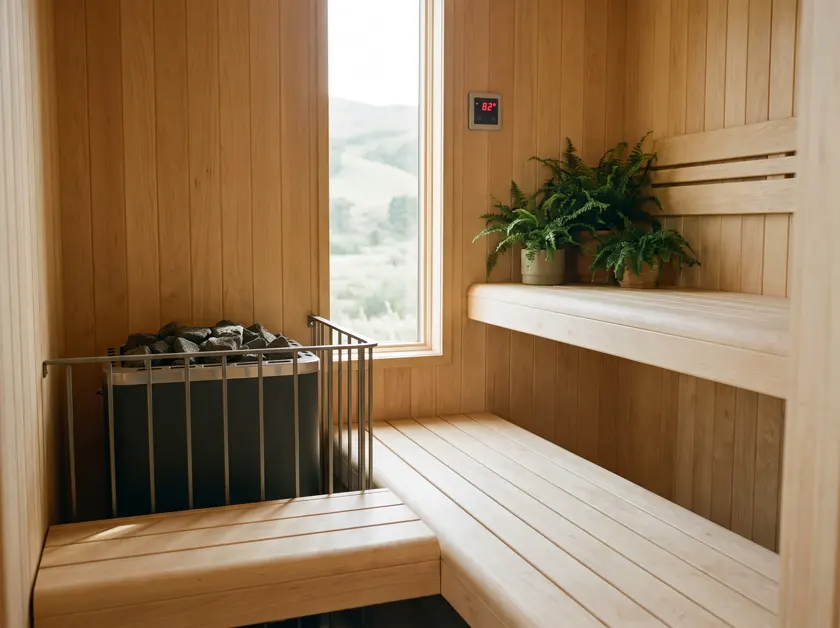
Custom saunas
A sauna for a Kigali hillside starts from the plot, not from a catalogue page. The slope decides what the cabi…
Read more →Rwanda earned USD 685 million from tourism in 2025 on 1.49 million visits, and meetings and events alone brought in USD 94.7 million (Rwanda Development Board). Lodges in Musanze, Nyungwe and Akagera and hotels in Kigali and on Lake Kivu now compete on what a guest can do once the day's activity is over — and a thermal suite is one of the few amenities used every evening.
Indicative band: RWF 24M – 120M, supplied and installed. Six to ten weeks per room from approved drawing to commissioning, plus the sea and road leg to Kigali.
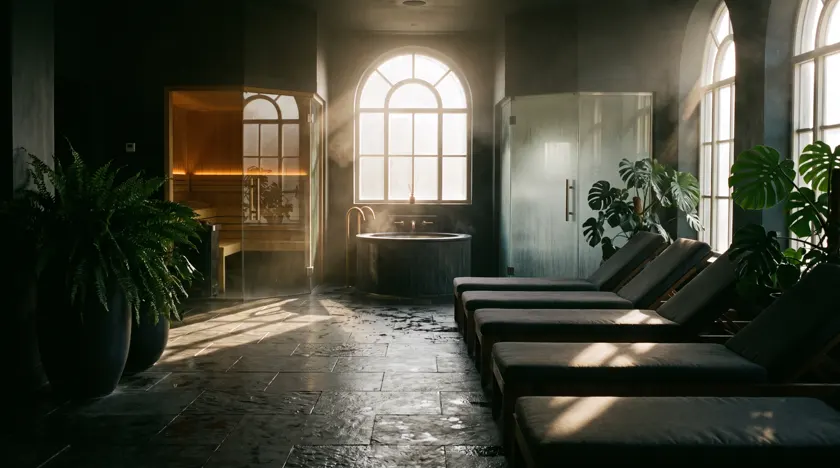
We plan hotel and lodge suites in three sizes. The bands come from our price list and cover supply, installation, EAC duty and 18% VAT; civil works and the incoming power supply are separate. Floor areas are typical planning figures that we refine against your drawings.
| Package | Typical area | Rooms included | Indicative, million RWF |
|---|---|---|---|
| Small | 28–35 m² plus 6–8 m² of plant | Sauna, steam room, two plunge positions, short rest bench | 24 – 52 |
| Medium | about 45–60 m² plus 8–10 m² of plant | Commercial sauna for 10–14, steam room for 4–6, private-scale hammam, two chilled plunge tubs, rest area | 37 – 69 |
| Full | 70 m² and up, with a separate plant room | Commercial sauna, steam room, hotel-scale hammam, sunken plunge pool, rest area, documentation, staff training, service contract | 53 – 120 |
The medium band is simply the sum of its rooms on our price list, which is why it overlaps both neighbours: a medium suite in porcelain can cost less than a small one in marble. Your quote itemises every room, so you can see where the money sits and take a line out without redrawing the project.
Guests go hot, cold, rest, and repeat two or three times. If the plunge is across a corridor from the sauna, or there is nowhere to sit and nowhere to hang a towel, the circuit breaks and the suite is used once per stay. We draw the sequence first and fit the architecture around it.
Capacity follows the busiest hour, which at a lodge is the ninety minutes after the trek or the game drive. As a planning rule, two plunge positions per eight sauna seats keeps guests moving; a single plunge beside a busy sauna builds a queue at the one thing your competitors lack.
Heat is the big load. A 12-seat commercial sauna of about 20 m³ needs roughly 19 kW at our altitude-corrected rate (20 × 0.85 × 1.12), so it gets a 21 kW heater; the steam generator for a 4–6 person room is another large draw; chillers are small by comparison, at roughly 0.75 kW of input per horsepower. None of these should start together, so we sequence them in the controls and stagger the heat-up times.
Grid-connected hotels pay REG's hotel rate of RWF 239 per kWh while annual consumption stays under 660,000 kWh, and RWF 175 above that threshold (tariff effective 1 October 2025, before VAT and the regulatory fee). In Kigali, Rubavu and Musanze the grid is usually the whole answer.
At an off-grid or weak-grid lodge in Akagera or Nyungwe the plan changes. Solar with batteries comfortably carries chillers, pumps, lighting and controls; carrying a 21 kW sauna heater through an evening on batteries means a very large and costly bank. Most remote lodges therefore run the heaters in a generator or grid window and keep the cold side on solar. Where firewood is on site and sustainably managed, a wood-fired sauna removes the biggest electrical load altogether. We size this with your energy contractor, not around them.
On a lodge built in phases, build the plant room first and slightly oversize it. Adding a room later is easy when the board, the drain and the space are already waiting.
A single room takes 6–10 weeks from approved drawing to commissioning; a complete package takes 12–16 weeks. On top of that sits the sea and road leg through Mombasa on the Northern Corridor or Dar es Salaam on the Central Corridor — 5–10 days overland from the coast to Kigali alone (Sino Shipping) — and then the road to the lodge. For a new-build hotel we work to the main contractor's programme, so the crates arrive when the rooms are ready for them.
At an operating lodge — gorilla trekking in Musanze runs all year — we install in agreed windows, keep the work area screened from guests, and commission room by room so part of the suite can open early. Staff training takes two days at handover, and we check the log book again at six months.
Our factory has been building since 1987 and has completed 220 hotel spa projects among 1,450 in total, including spa floors for Hilton, Hyatt, Kempinski and Rixos properties. In Rwanda, our crew built three villa spas for a residential resort in Kigali — each villa with a panoramic-glass sauna and a steam room lined with a waterproof membrane and glazed to full height — exported from the factory and installed on site.
Before committing, most owners want to know whether the numbers work. We have set out does a lodge spa pay back with RWF figures, and the regulatory side — grading, permits and the plant room — in adding a spa to a Rwandan hotel or lodge.
About 28–35 m² for a sauna, a steam room, two plunge positions and a short rest bench, plus 6–8 m² of plant. Below that you are building one thermal room with a shower — a fine product, but not a suite.
Yes, with planning. Heaters and chillers are the big loads and must not start together; we sequence the controls so the suite never trips the changeover when the mains drops.
Two days at handover: operation, cleaning chemistry, water testing, what to do when a reading looks wrong, and how to keep the log. We come back at six months to check the log is being kept.
Send a photo of the space and the room dimensions. A project manager replies within one business day with photos of finished rooms like yours and an itemised quote.
A sauna for a Kigali hillside starts from the plot, not from a catalogue page. The slope decides what the cabi…
Read more →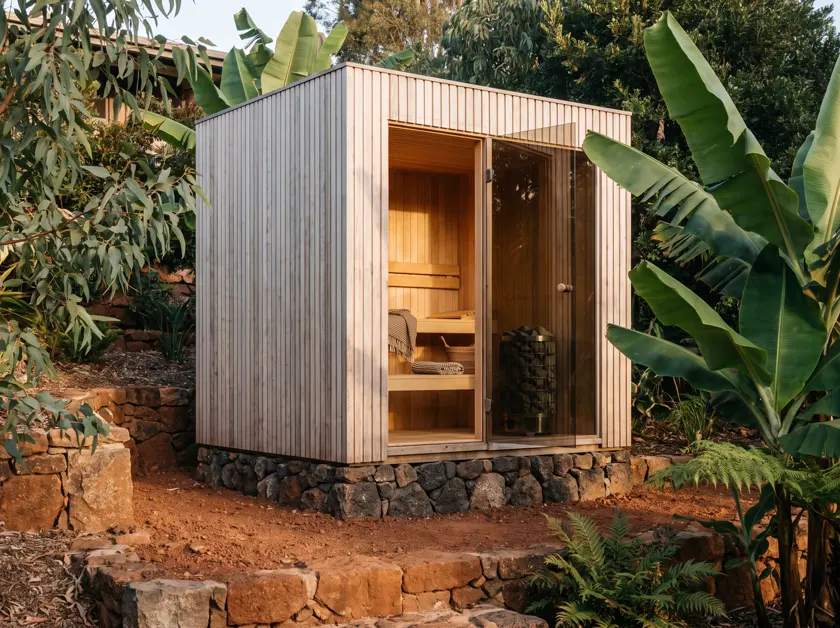
Almost every garden we survey in Kigali is terraced, and that one fact settles most of the engineering. An out…
Read more →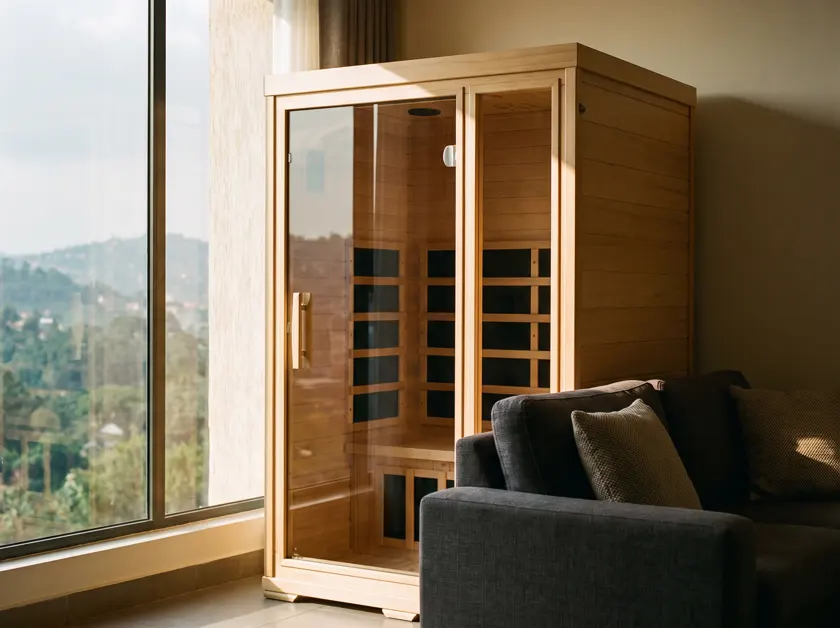
Most Kigali apartments come with a single-phase supply, no floor drain and a landlord who would rather nothing…
Read more →