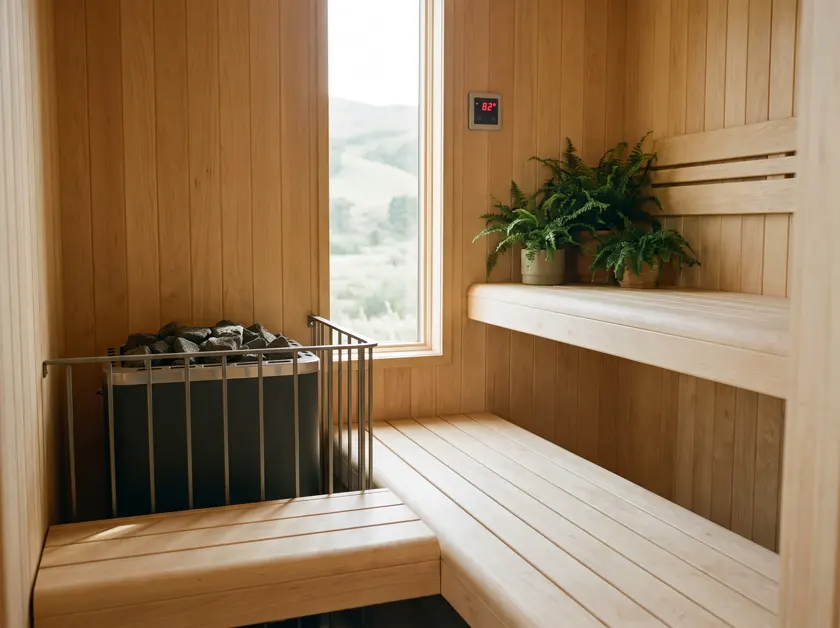
Custom saunas
A sauna for a Kigali hillside starts from the plot, not from a catalogue page. The slope decides what the cabi…
Read more →The chiller decides whether a cold plunge still works in year three. It is also the part people buy blind, from a marketplace listing, at the wrong size.
Indicative band: RWF 2.2M – 7.4M, supplied and installed. Six to ten weeks per room from approved drawing to commissioning, plus the sea and road leg to Kigali.
| Tub volume | Chiller | Typical setpoint |
|---|---|---|
| up to ~260 litres | 1 HP | 8–10 °C |
| up to ~570 litres | 2 HP | 8–10 °C, lower with a good lid |
| up to ~1,200 litres | 4 HP | 4–10 °C |
We step up one size when the tub stands in afternoon sun, when a team uses it back to back, or when the target is 4–6 °C rather than 8–10 °C. Supplied and fitted, a chiller sits in the 2.2 – 7.4 million RWF band depending on that size, with duty and VAT inside.
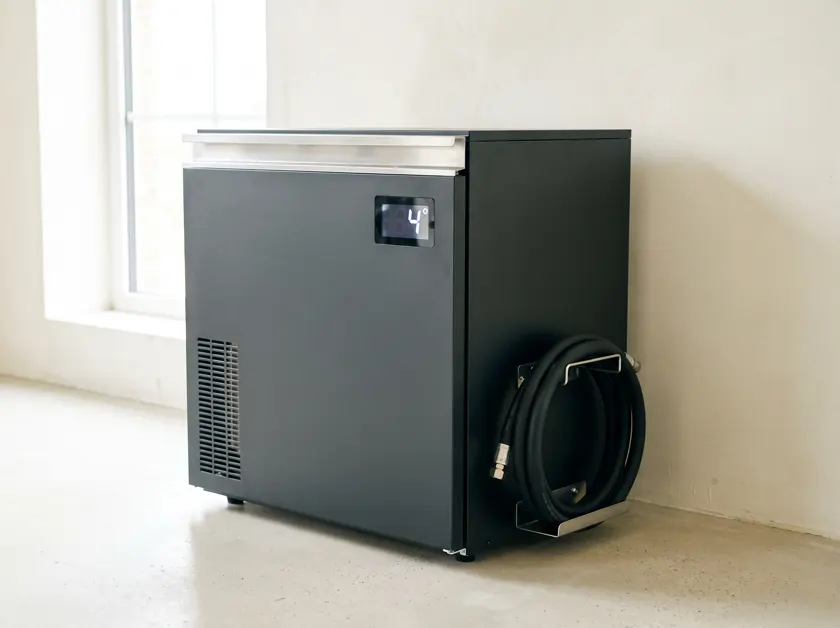
Our units are outdoor-rated cabinets with a titanium heat exchanger — titanium because the water is cold, circulating and often ozonated, and stainless steel pits under exactly those conditions. The cabinet carries the display, a circulation pump and insulated hoses that enter low in the tub wall, so nothing crosses the rim for anyone to trip over.
We set the unit to hold its setpoint in cycles rather than running flat out. The insulated lid does the overnight work, and the compressor gets a working life instead of a warranty period.
A chiller needs air. Boxed into a cupboard with no airflow it runs hot, loses capacity and fails early. We give it a shaded position with clearance on the grille side, out of the afternoon sun, and bury or box the hoses.
On a hillside plot in Kigali the neatest spot is often a niche in the retaining wall below the tub: gravity helps the circulation and the unit disappears from view.
Compressor power is roughly 0.75 kW of electrical input per horsepower, so a 2 HP unit draws about 1.5 kW while it runs. How many hours it runs depends on the insulation, the lid and the gap between water and air — and at 1,450 m, where nights fall to 16–17 °C, that gap is small.
A labelled example, not a promise: six running hours a day is about 9 kWh, or some 270 kWh a month. At REG's household rate of RWF 369 per kWh above 50 kWh a month (effective 1 October 2025, before VAT and the regulatory fee) that is close to RWF 100,000 a month. A gym on the non-residential tariff pays RWF 376 per kWh above its first 100 kWh.
Condenser coils clog with dust in the dry season, especially near an unpaved road. We service on a six-month cycle — clean the condenser, read the refrigerant pressures, change the cartridge, test the ozone cell — and on a three-month cycle near dusty savannah roads. It takes about an hour and it separates a chiller that lasts eight years from one that dies in three.
The tub the chiller serves is described on the cold plunge page, and how the units reach Kigali is explained in importing sauna equipment to Rwanda.
Yes, if parts are obtainable. Send us the model plate before you buy, though — a unit two sizes too small for its tub is the commonest problem we find, and no service visit fixes that.
Roughly like the outdoor unit of a domestic air conditioner. On a tight plot in Nyarutarama where neighbours are close, we place it behind the retaining wall and it disappears.
An insulated tub with its lid on holds temperature for many hours, so short outages go unnoticed. The unit restarts on its own when power returns.
Send a photo of the space and the room dimensions. A project manager replies within one business day with photos of finished rooms like yours and an itemised quote.
A sauna for a Kigali hillside starts from the plot, not from a catalogue page. The slope decides what the cabi…
Read more →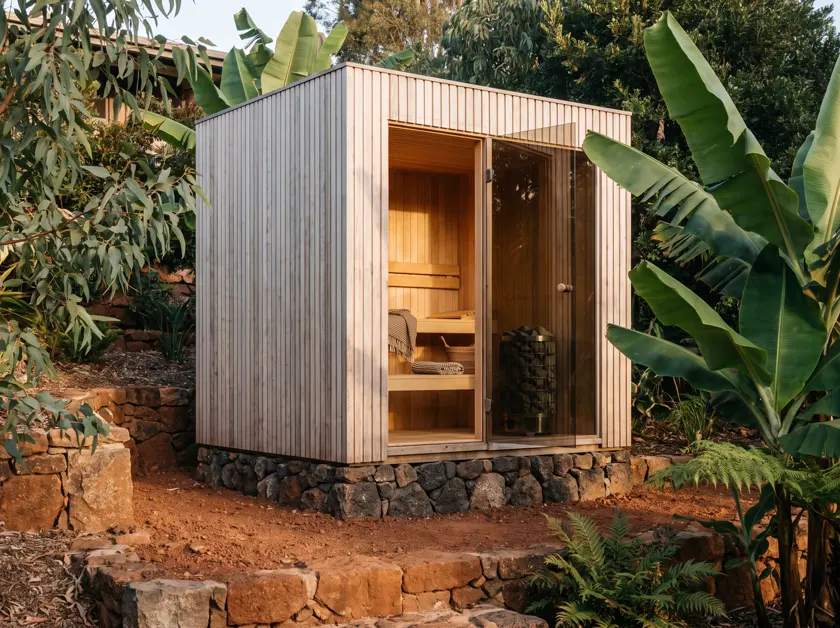
Almost every garden we survey in Kigali is terraced, and that one fact settles most of the engineering. An out…
Read more →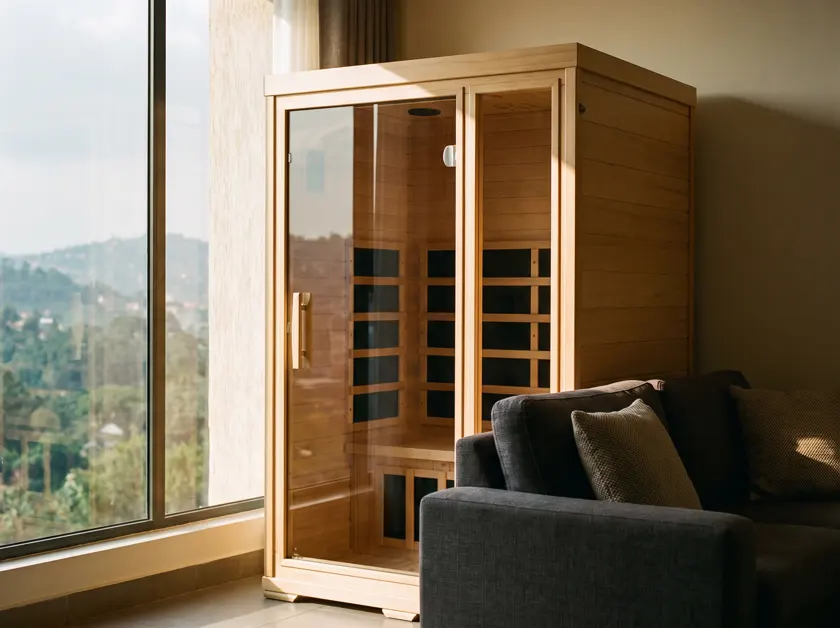
Most Kigali apartments come with a single-phase supply, no floor drain and a landlord who would rather nothing…
Read more →