9 min
What a Sauna and Cold Plunge Cost in Rwanda in 2026
An honest breakdown of sauna and cold plunge prices in Rwanda: what sits in the lower bands, what pushes a cab…
Read more →They are not variations of the same thing, and for a lodge the choice between them is a commercial decision before it is a design one. Here is how they differ, and how to do the arithmetic.
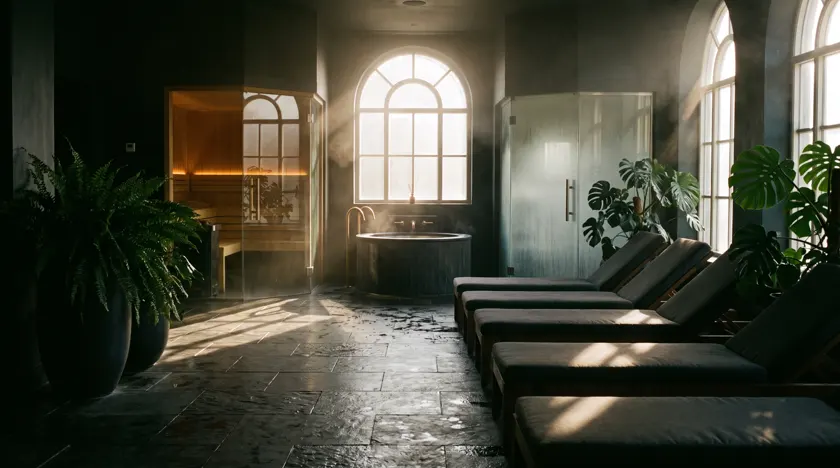
Dry air at 80–95 °C, with humidity raised in bursts when water hits the stones. Heat-up is twenty to forty minutes, sessions are short and intense, and the room is timber — so the build is dry trades only: no tanking, no falls, no drain.
It is the cheapest of the three to build and the most forgiving to install, which is why it is where most households and most small lodges start. It is also the one with the highest peak electrical load, which matters on a lodge running its own generation.
Saturated air at 42–48 °C. Far gentler on the chest than a sauna, and much more popular with guests who find dry heat uncomfortable — which is a larger group than most operators expect.
It is also a construction project rather than a carpentry one: a waterproof tank, falls to a drain, a pitched or domed ceiling and a generator that has to live somewhere serviceable. Lower peak load than a sauna, longer run, plus water.
If you have room for exactly one and your guests include people who dislike dry heat, build this one. It is the one we most often recommend and the one operators most often arrive not having considered.
Warm humid air at 40–50 °C, with the real heat stored in a marble slab guests lie on, held at 40–45 °C. Sessions are long — an hour is normal — and it is social in a way the other two are not.
It is the most expensive of the three, the heaviest, and by a distance the one that makes the strongest impression on a guest. Consumption is the steadiest of the three, because the slab is generally left on.
In Kigali we build more hammams for villas in Kiyovu than anywhere else in the country, and for a lodge it is the room that appears in photographs.
Not which is best. Which one the people in your house — or your guests, after a day in the field — will actually walk into on a Tuesday evening when they are tired.
For a lot of Rwandan families that answer is steam, and they build a sauna because that is what they have heard of. For a trekking lodge the answer is usually the sauna, because guests come back cold and want heat quickly rather than a long session. For a resort or a city villa with entertaining in mind, the hammam earns its cost.
We would rather ask those questions at the first meeting than design the room somebody expected to want.
Rwanda's tourism revenue reached USD 685 million in 2025, up 6 per cent on 2024, from 1.49 million visits, a 9 per cent rise, with air arrivals growing fastest at 23 per cent (Rwanda Development Board).
The MICE segment alone generated USD 94.7 million in 2025 across 165 events and 61,888 delegates, up 17.3 per cent year on year (Rwanda Development Board).
Conference delegates are a specific and underrated kind of spa customer: they arrive in groups, their evenings are free, and somebody else is paying for the room. A city property with a credible thermal suite is competing for that business against properties that have a tired gym and a pool.
Rate. A property that can credibly list a thermal suite competes in a higher bracket. This is the largest effect and the hardest to isolate, because it appears as occupancy at a better rate rather than as a line item on a report.
Treatment revenue. The direct line, and the one that depends entirely on staffing. A beautiful suite with nobody trained to sell treatments earns very little, and we have seen that outcome more than once.
Length of stay and review score. Harder to measure, and real. Wet areas appear in guest reviews disproportionately — positively when they work and viciously when they smell.
Build cost. For a small suite — sauna, steam room, two plunge positions, a short rest bench and plant — start from around 28–35 m² of floor area plus 6–8 m² of plant, and argue for the plant space at design stage rather than losing it.
Running cost: energy, water, chemistry and filter cartridges. In Kigali the cold side is cheap, which genuinely helps this arithmetic compared with a coastal property.
Staff: at minimum one trained person who owns the log book. Maintenance: a six-month service cycle, and three-monthly on chiller condensers in dusty upcountry locations.
And the one operators forget: twenty minutes a day of somebody's time, every day, for water testing and cleaning. A suite nobody has time to maintain degrades visibly within a season.
Work out how many additional room-nights at your actual rate would cover the annual cost of running the suite plus the build amortised over five years. That is one number and you already have every input.
If it is a small fraction of your current occupancy, build it. If it needs your property to fill ten per cent more, be sceptical — and talk to us anyway, because a smaller suite frequently clears the bar when a large one does not, and a sauna-plus-plunge deck with no steam room is a fraction of the cost and a large share of the effect.
We will not hand you a return-on-investment percentage. Anyone who does, without seeing your occupancy and your rate, is selling rather than advising.
Undersizing, so there is a queue at the one thing your competitors do not have. Siting, so the circuit from hot to cold crosses a public corridor and guests use the room once per stay. And staffing, so the water quality drifts and the reviews turn.
All three are decided before anything is built. Size on the busiest evening, lay out the circuit properly, and budget the twenty minutes a day. We train your team for two days at handover and come back at six months to check the log is being kept, because a suite that degrades reflects on us as much as on the property.
Want this checked against your own room? Send us the dimensions and a photograph and we will come back with a drawing.
An honest breakdown of sauna and cold plunge prices in Rwanda: what sits in the lower bands, what pushes a cab…
Read more →
Why a heater sized from a sea-level chart never gets properly hot in Kigali — and why the same 1,450 metres ma…
Read more →
Every imported component reaches landlocked Rwanda through somebody else's port. The two corridors, realistic …
Read more →