
9 min
What a Sauna and Cold Plunge Cost in Rwanda in 2026
An honest breakdown of sauna and cold plunge prices in Rwanda: what sits in the lower bands, what pushes a cab…
Read more →Rwanda is landlocked, so every imported component arrives by sea to somebody else's port and then travels by road. Planning a project without that in the schedule is how installations slip by a month.
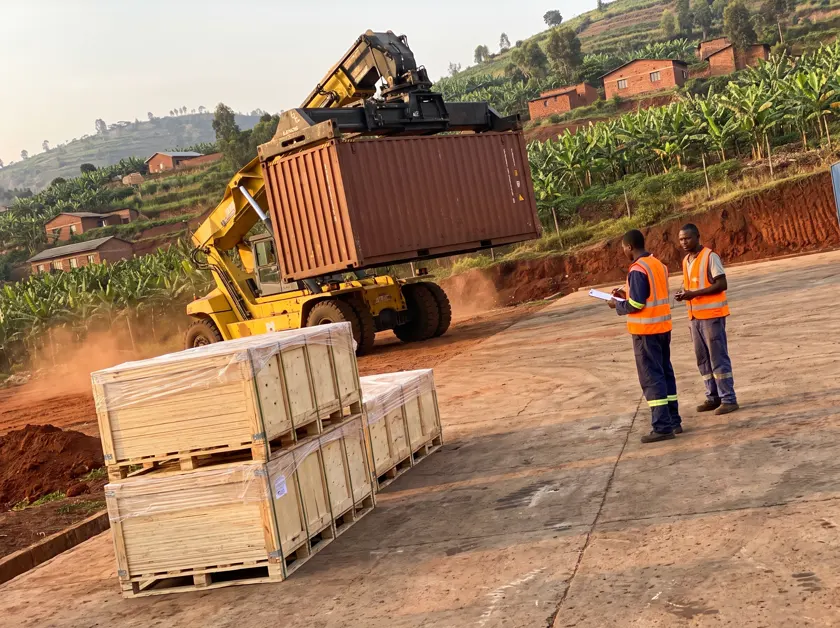
The Northern Corridor runs from Mombasa in Kenya through Uganda to Kigali. The Central Corridor runs from Dar es Salaam in Tanzania directly into Rwanda (UN-OHRLLS). Both are used routinely, and which is faster in any given month depends on port congestion and border processing far more than on distance.
We do not commit to one at order stage. We watch what is actually moving and route accordingly, which occasionally means splitting a project across two shipments when one corridor is clearly slower. A supplier who always uses the same route is optimising for their own paperwork rather than for your programme.
Rwanda and Tanzania have been deepening the Dar route, and the Kigali Logistics Platform — a dry port of more than 30 hectares with capacity for 50,000 TEU, operated by DP World — connects to both ports and extends toward Goma, Bukavu and Rusumo (DP World Kigali). For us that means clearance can happen in Kigali rather than at a border post, which is a meaningful difference on a container full of timber.
Sea freight to the East African coast runs 35–42 days for a full container and 36–46 for consolidated cargo. Add 5–10 days overland from Mombasa or Dar to Kigali, depending on road conditions and border clearance (Sino Shipping).
So from order to Kigali, six to eight weeks is a normal, honest figure for anything that has to be shipped. Anyone quoting you two weeks is either holding stock — ask to see it — or has not thought about it.
Air freight exists and is entirely sensible for a heater, a controller or a replacement board. It is not sensible for timber, and a supplier who offers to air-freight a cabin is quoting you a number you will not enjoy.
Rwanda applies the EAC common external tariff on the CIF value, in bands of 0, 10, 25 and 35 per cent, with capital goods and raw materials at the low end and finished goods at the top (trade.gov). VAT is 18 per cent (PwC Tax Summaries).
The practical consequence is simple arithmetic: importing a complete finished cabin attracts finished-goods treatment, while importing timber and components and building them here does not. That is a large part of why we run a joinery in Gisozi rather than reselling flat-packs, and it is why our landed price on a comparable cabin is frequently below an imported one even before freight.
It also means a client who imports a cabin themselves is usually surprised twice: once by the tariff band and once by the fact that nobody local will warrant somebody else's assembly.
We keep the failure-prone items in stock in Kigali: heater elements, thermostats, overheat cut-outs, filter cartridges, hose seals and A4 stainless fixings. Those are the things that stop a room working, and a six-week wait for a thermostat is not a service proposition.
Everything else is ordered against a project. Timber is the long pole, and it is ordered the day a drawing is signed rather than when the groundwork finishes.
Clear the drawing early, order long-lead items first, and keep the wet trades and the electrical run happening while the timber is on the water. On a well-planned project the container arrives into a site that is already prepared, and assembly is a week rather than a month.
The corollary is that changes are cheap before the order and expensive after it. We would much rather spend an extra meeting on the drawing than an extra month on the programme, and we will push back on a rushed sign-off even when the client is keen to start.
If you are building a house, the single most useful thing you can do is lay the cable, the conduit and the drain during the build, whatever the sauna timetable turns out to be. That decision costs almost nothing when a trench is already open and several times as much afterwards.
A Kigali project ends when the container reaches Gisozi. A Musanze, Rubavu, Karongi or Nyungwe project does not: there is a road leg after that, and on some lodge approaches the last kilometre is the difficult part rather than the first thousand.
We survey those approaches before quoting, size panels to the tightest turn and the roughest section, and schedule upcountry deliveries and site visits in blocks so several projects share the travel in the same week. That block scheduling is why our upcountry surcharge is modest and predictable rather than improvised.
Clients regularly send us a link to a cabin that looks cheap. The comparison people make is the sticker price against our quote, and it is the wrong comparison by a wide margin.
Add sea freight for a bulky, low-density item. Add the finished-goods tariff band rather than the components band. Add 18 per cent VAT on the whole landed value. Add clearance and the overland leg to Kigali. Add a crane or a crew to move it from a lorry to a terraced garden, because it arrives in one piece. Then add the heater, because the good ones are rarely included, and the electrical work, because nobody ships that.
Then subtract the things you do not get: a warranty anybody local will honour, a heater sized for 1,450 metres, insulation specified for this climate, a service visit, and a spare element on a shelf in Gisozi. We have been asked to repair three of these and in each case the honest advice was to re-line the shell.
None of that is an argument that our number is small. It is an argument that the two numbers are not comparable, and we would rather set them side by side than pretend the question was not asked.
Port congestion, a border queue, a damaged crate or a missing item on a packing list. None of them are exotic and all of them are survivable if the programme has honest slack in it and if the critical items were ordered first.
We pack against a written checklist that somebody signs, we photograph the load, and we carry a margin of consumables and fixings rather than exactly the quantity calculated. The margin costs very little; being short by a bracket six weeks from a replacement costs everybody.
And when something does slip, we say so the day we know rather than the week the client asks. A landlocked supply chain will occasionally disappoint you. Being told late is what turns that into a problem.
Want this checked against your own room? Send us the dimensions and a photograph and we will come back with a drawing.
An honest breakdown of sauna and cold plunge prices in Rwanda: what sits in the lower bands, what pushes a cab…
Read more →
Why a heater sized from a sea-level chart never gets properly hot in Kigali — and why the same 1,450 metres ma…
Read more →
Eucalyptus is Rwanda's most available timber and the first thing every client asks about. Why it fails in a ho…
Read more →