
8 min
What a Sauna and Cold Plunge Cost in Rwanda in 2026
What a sauna and cold plunge cost in Rwanda in 2026: cabin, heater, chiller, duty, VAT and install in RWF, plu…
Read more →Football academies, rugby squads, padel clubs and ordinary Kigali gyms now ask for ice baths as a matter of course. The tub is the easy part. The protocol, the rotation and the water hygiene are what decide whether it helps a squad or just gives it something to queue for.
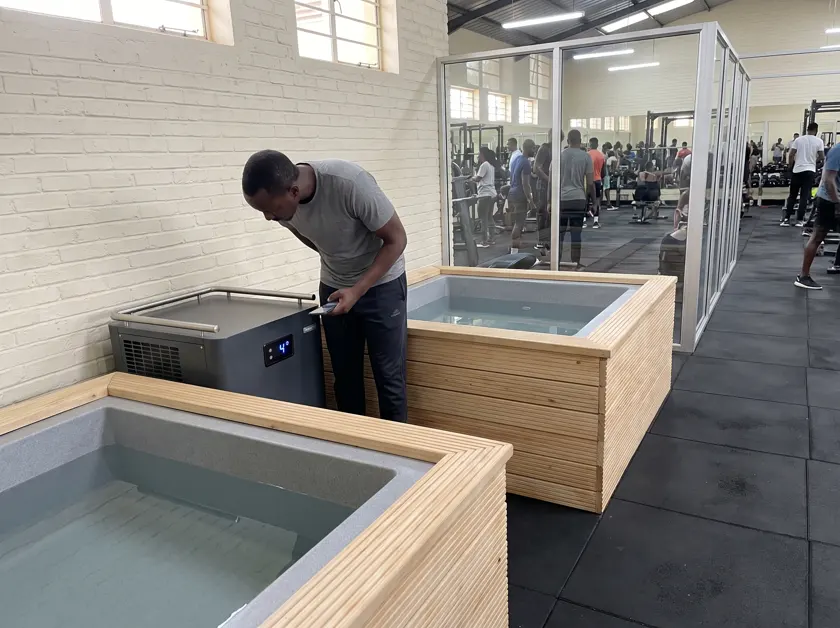
Cold-water immersion is one of the most widely used recovery tools in sport, and athletes commonly report that it eases the feeling of soreness after hard sessions. The research picture is more mixed than social media suggests: effects vary between people and sports, and some studies suggest that plunging straight after every strength session may blunt part of the training adaptation. We build tubs; we do not prescribe them.
So the sensible starting point for any Kigali club is to let the coach or physiotherapist set the protocol, and to build equipment that delivers it precisely: a stable temperature, room for the squad, and clean water every day. Nothing here is medical advice, and anyone with a heart condition, high blood pressure or circulation problems should speak to a doctor before using cold water.
The requests we build for sit in a fairly narrow band: water somewhere around 8–15 °C, and immersions measured in minutes rather than quarter-hours. Colder is not automatically better. A tub that holds 10 °C reliably is more useful than one that swings between 4 °C and 14 °C during a busy session.
What decides stability is capacity against load. Twenty warm bodies passing through a 500-litre tub in half an hour dump a surprising amount of heat into the water, so a squad tub needs a chiller sized for recovery time as well as volume, a lid between waves, and a thermometer the physio can read without leaning over the rim.
At about 1,450 m, Kigali's nights fall to 16–17 °C and its days rarely pass 28 °C (Climates to Travel). A chiller fights the difference between the water and the air, and here that difference is small, especially overnight. The practical result is a smaller unit for the same tub, fewer running hours and a lower REG bill than the same installation would need in a hot lowland city.
Altitude also shapes the training around the tub: squads working at Kigali's elevation are training in thinner air, and recovery between sessions is part of the coaching plan. That plan is the coach's business, not ours; our job is to make sure the water is at the right temperature when the coach wants it.
A squad of twenty-five after training is the hardest case. With about three minutes in the water and two to get in and out, one tub clears roughly six players in half an hour. Four tubs, or one sunken pool seating six to eight, clear the whole squad in about the time it takes the last group to finish stretching.
| Squad size | Positions for a 30-minute window | Typical build |
|---|---|---|
| 8–10 (padel, tennis, a small gym class) | 2 | Two tubs with 1 HP chillers |
| 15–18 (sevens, volleyball, basketball) | 3 | Three tubs, or a basin for four |
| 22–25 (football, fifteens rugby) | 4, or a pool | Four tubs, or a sunken pool for 6–8 |
Print the rotation, give each group a start time and put the thermometer reading on the same board. It removes the queue and most of the arguments.
Separate tubs are easier to install, can each be held at a different temperature, and let a club add capacity one tub at a time. A sunken pool for six to eight takes a squad in fewer waves and looks the part in a stadium or an academy, but it needs a plant room, a stronger slab or an excavation, and a permanent decision about its position.
Most Kigali gyms and padel clubs are better served by tubs. A football academy with its own building, or a stadium changing area, is where a pool starts to make sense. Indicatively, a chilled tub is 3.4 – 7.4 million RWF depending on its size, and a sunken pool for six to eight is 14 – 28 million.
Between the changing room and the showers, not across a corridor: players should walk wet over as little floor as possible. Keep the chillers outside the wet area, shaded and ventilated, and run the power and drainage before the floor is finished. On an upper floor, have the slab checked first, because a large tub is close to a tonne when full.
Shared cold water is where recovery zones go wrong. On every club tub we fit a circulation pump, a filter cartridge and ozone or UV treatment, and we put a shower by the way in, because embrocation, sweat and sunscreen are what cloud squad water first.
Nobody plunges alone. Fit entry steps and a handrail, lay a non-slip floor with falls to a drain, and keep a member of staff within sight during squad sessions. A towel point and warm clothing right by the exit matter more than people think, especially on a Kigali evening when the air is already cool.
Children and junior players need their own rules — shallower water, shorter times, an adult at the tub — and those rules belong to the club's medical staff.
Many clubs pair the tubs with a sauna. Heat and cold do different jobs, and whether a player uses one, the other or both in sequence is a matter for the coaching plan rather than a rule. For a gym, a compact sauna beside two or three tubs is the usual layout; for a squad, the tubs come first and the sauna is sized smaller.
As a guide, two tubs and a sauna for a gym come to 6.5 – 14 million RWF, and a four-tub squad zone with its own shower and full filtration to 15 – 32 million, landed and installed. On the electricity side a club is a non-residential REG customer, so nearly all of its chiller consumption is billed at 376 francs a kWh (tariff in force since October 2025).
The layout, drainage and slab questions are covered on our gym recovery zone page, the tubs themselves on cold plunge pools, and chiller sizing on ice bath chillers. Send us your squad size and the room, and a project manager will reply within one business day.
Want these numbers worked out for your own room in Rwanda? Send the dimensions and a photograph — we answer within one business day with an itemised quote.
What a sauna and cold plunge cost in Rwanda in 2026: cabin, heater, chiller, duty, VAT and install in RWF, plu…
Read more →
Sauna electricity in Rwanda: the REG tariff from October 2025, when you need three-phase, and what a session c…
Read more →
Adding a sauna, steam room or plunge to a Rwandan hotel or lodge: grading, building permits, park rules, power…
Read more →